Showing posts with label Newfoundland Regiment. Show all posts

Monday, 1 July 2019

BEAUMONT HAMEL, SOMME

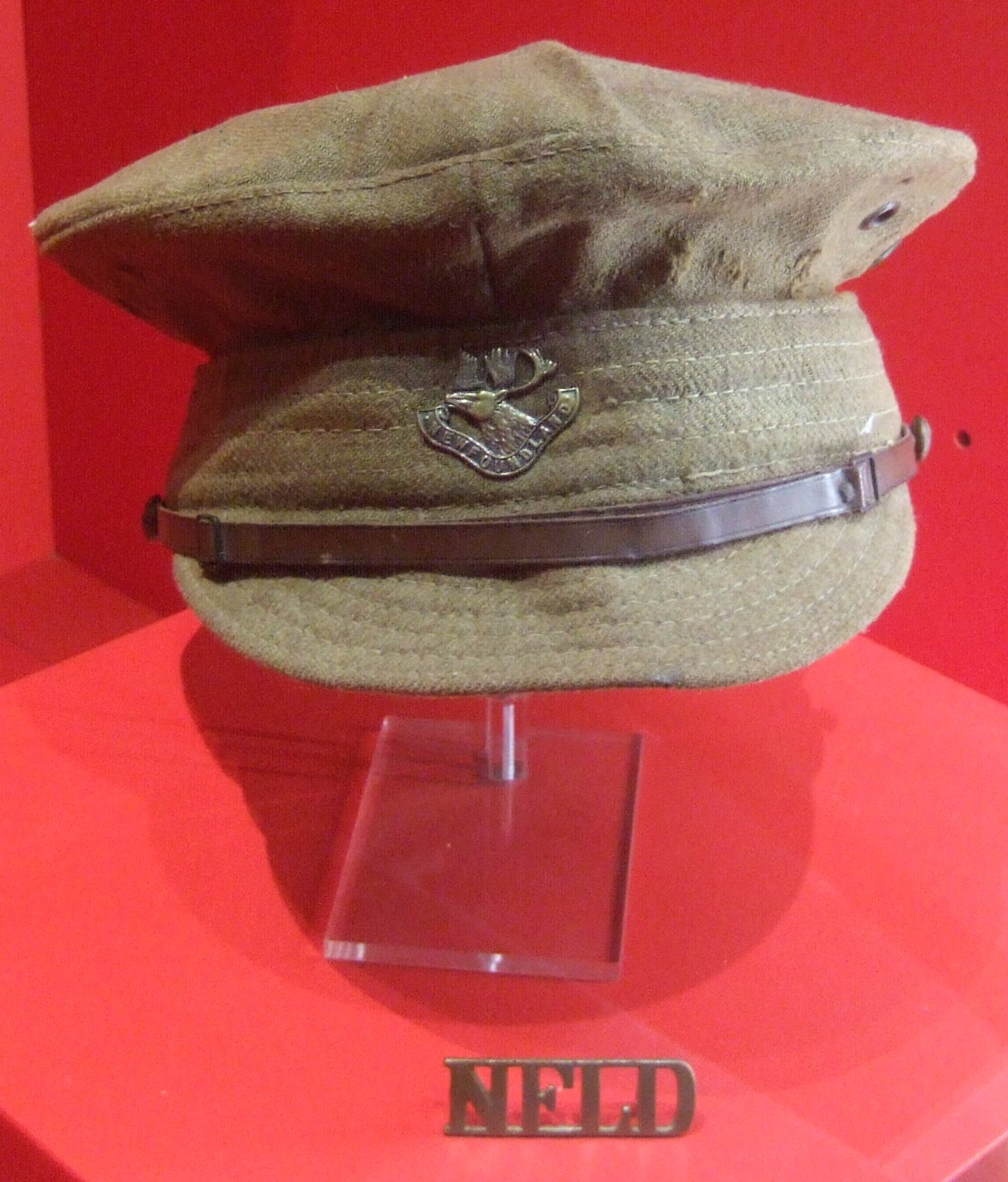
Cap with original Badge, in Museum in Ypres
Sir Douglas Haig, Lieutenant General in command of the Corps, wrote a letter to the Government of Newfoundland expressing his appreciation of the Regiment's splendid courage and determination on 1st July 1916.  Here is part of what he wrote.

"That Battalion covered itself with glory on July 1st by the magnificent way in which it carried out the attack entrusted to it.  It went forward to the attack when two other attacks on that same part of the line had failed, and by its behaviour on that occasion it showed itself worthy of the highest traditions of the British Race, and proved itself to be a fit representative of the population of the oldest British Colony.  When the order to attack was given every man moved forward to his appointed objective in his appointed place as if on parade.  There were no waverers, no stragglers, and not a man looked back.  It was a magnificent display of trained and disciplined valour, and its assault only failed of success because dead men can advance no farther."  
"Better than the Best"

Saturday, 22 June 2019

"GLORIOUS SURVIVORS"

While never forgetting those who died, in the next few days we will remember those who fought and survived the horrors of World War I. Padre Thomas Nangle referred to them as "glorious survivors".  

Cathy Taylor entered Kindergarten at Mercy Convent about 1963.  The following year she started Grade 1 at St Patrick's Convent.  Cathy remembers Sr Kieran, her teacher, very well and she  still has her Report Card from that year. She must have been a good student because she came first in her class! Cathy graduated from St Patrick's, Grade 9, in 1971 and moved on to Holy Heart of Mary High School.  In this post Cathy Taylor Coffey pays a fond tribute to her grandfather,  Sgt Victor Taylor, who enlisted on 2nd September 1914. 
Sgt Victor Taylor, Newfoundland Regiment Number 111
"My grandfather was Victor Taylor, and he was one of the First Five Hundred in the Royal Newfoundland Regiment, number 111.  He was born on November 10, 1889. He grew up on the South Side Road, and later lived on Topsail Road, and then on Craigmillar Avenue, where I grew up. He was a machinist by trade and worked at Job’s down at the docks.

He survived the battle of Beaumont Hamel on July 1, 1916. I had always thought that he was one of the 68 that answered roll call on July 2, 1916, but my Aunt Patricia (married to John Taylor, my uncle) had recently informed me that he was not on that list. 

I do know that he was one of three ‘runners’ that day, so he would have been one of the first to go over the top that morning. This was according to one of the staff at Beaumont Hamel Memorial in France that I spoke to in June, 2000. 

As to what happened to him that day we will never know. He never spoke of the war much to us, but he did speak to my Uncle Gus Blackwood who was in the Air Force (married to my aunt, Mary {Taylor} Blackwood). Like many, he was probably more comfortable sharing stories with someone else who had also served.

Although my grandfather did not often speak of the war, he was very proud of the Newfoundland Regiment. When I was little he used to sing us his marching songs, “Mademoiselle from Armentieres”, taking care to leave out the naughty bits! He also talked a little about life in the trenches. He had issues with his feet throughout his life as a result of frostbite, and also issues with the skin on his face from mustard gas, which he survived by urinating in his handkerchief and covering his face with it. He never told us about this, but Uncle Gus told me. He was also hospitalised for a time with dysentery. 

Luke, at the Danger Tree, 
Newfoundland Memorial Park, Beaumont Hamel


In June, 2000, we took our youngest son, Luke, to The Somme and  Beaumont Hamel. I was the first grandchild and Luke was the first great grandchild to visit the site. Luke’s train ticket number from Paris to Amiens was '111', which was Pops’s regimental number. It was a very emotional experience for me as I walked through the remnants of those same trenches where he would have walked under very different circumstances.

Every year my grandfather gave me money to get a poppy for myself and him, and so I would stop at that little store at the foot of Patrick Street on my way home from school. I remember the store clerk always saying it was too much money, but it was what my Pops wanted me to pay, so I did. 

I wear my poppy for him especially, every Remembrance day."

Thank you very much for sharing this lovely personal story with us Cathy.  Imagine Luke's ticket being number 111!  That was an amazing coincidence and I expect you have saved the ticket.  I think your grandfather would be as proud of you as you are of him.

Friday, 14 June 2019

WHAT THEY SAID

I think you all know that St Patrick's Convent School, Deanery Avenue, which  opened in 1921, was built as a Memorial to those of the parish who fell in WWI. Every year, on 1st July, Newfoundlanders remember them and all who fell in that brutal conflict.  This Blog also tries to honour them in some small way.  For that reason, in the couple of weeks leading up to 1st July, the posts will concentrate on our Regiment and its men.  In this first post, "WHAT THEY SAID", I will simply quote what some others have said in regard to the Newfoundland Regiment.
The plaque from St Patrick's Convent School,  Deanery Avenue 
In Scotland, they were popular with the locals and on 25th April 1915, The Edinburgh Evening News said "THE NEWFOUNDLANDERS WILL LEAVE BEHIND THEM THE NAME OF A MODEL REGIMENT, WHICH KNEW HOW TO HONOUR ITSELF AND THE PLACE WHENCE IT CAME."

Of course, their bravery in the face of terrible odds also impressed those who fought alongside them.  After the horror of 1st July an eyewitness, Pte F H Cameron of the King's Own Scottish Borderers had this to say, "ON CAME THE  NEWFOUNDLANDERS, A GREAT BODY OF MEN, BUT THE FIRE INTENSIFIED AND THEY WERE WIPED OUT IN FRONT OF MY EYES.  I CURSED THE GENERALS FOR THEIR USELESS  SLAUGHTER - THEY SEEMED TO HAVE NO IDEA OF WHAT WAS GOING ON."    
Throughout the war, the Newfoundland Regiment was highly thought of as a  brave and dependable body of men - a Regiment to be trusted and to rely on.  In October 1918 there was ferocious fighting in the Steenbeck.  A respected British Officer, Brigadier General Freyberg,  heartened to learn that his left flank was being protected by the Royal Newfoundland Regiment remarked, "THANK GOD, MY LEFT FLANK IS SAFE!"
In a letter to the Government of Newfoundland, Sir Douglas Haig, expressed his admiration of the Regiment's courage and determination on 1st July, 1916.  "I SHOULD LIKE YOU TO LET MY FELLOW CITIZENS OF THE EMPIRE IN THE OLDEST OVERSEAS PORTION OF THE BRITISH REALM KNOW HOW WELL THEIR LADS HAVE DONE......., HOW PROUD I, AS THEIR CORPS COMMANDER, AM TO HAVE HAD SUCH A BATTALION UNDER MY COMMAND, AND TO BE A COMRADE IN ARMS OF EACH AND ALL OF THEM. 
NEWFOUNDLANDERS, I SALUTE YOU!  YOU ARE BETTER THAN THE BEST."

Tuesday, 6 November 2018

A YOUNG " BLUE PUTTEE"

I trust I am not overdoing it with the military posts here?  This is the third such post.  (As my late mother-in-law would probably say "over egging the pudding"!)  Every 11th November we remember those who gave their lives in the pursuit of justice and freedom.  Some of us have personal reflections but mostly we remember them collectively.  As this year is the centenary of the official ending of WWI, in the days leading up to Armistice Day I want to tell a little of their personal stories so that we can see them as they were - ordinary people who did extraordinary deeds!  

Michael John Blyde was the son of John and Mary Blyde of 47 Fleming Street, St John's.  He enlisted at St John's on 5th September 1914, Regimental Number 280, one of the illustrious First Five Hundred.  His Attestation Papers tell us that this blue eyed single man was a  "Shoe Cutter"  earning $12 per week.  On 4th October Pte M J Blyde embarked St John's aboard the SS Florizel.

It was about a year before the Newfoundland Regiment was deployed.  In August 1915 word came that they were going to Suvla Bay in the Gallipoli Peninsula.  There they would join the 88th Brigade of the 29th Division of the British Army. Private Blyde was with his Regiment when they disembarked Alexandria on 1st September 1915.  Two weeks later they embarked for Gallipoli.  

280, Pte Michael John Blyde
Gallipoli was a Hell Hole with shells bursting all around. The first Newfoundland casualty came on 22nd September when 21 year old Pte Hugh McWirter was killed by a Turkish shell.  Pte Blyde would not be far behind his comrade. On 26 September 1915, 19 year old Pte Michael John Blyde was killed in action at Suvla, Gallipoli.  He rests there with seven other fallen Newfoundlanders in Hill 10 Cemetery.
Hill 10 Cemetery

Resting place of Pte Michael John Blyde

I am very grateful to my nephew for the use of his photos of Hill 10 Cemetery and Pte Blyde's grave.

Friday, 1 July 2016

ONE HUNDRED YEARS AGO TODAY

Distance Marker on Monument at
Newfoundland Memorial Park, Beaumont Hamel
Pte E J Murphy
During WWI, the Newfoundland Regiment served bravely and with distinction in Turkey, Egypt, France, Belgium, Greece, Germany and Great Britain.   Despite its many courageous battles, it is Beaumont Hamel and the first day of the Battle of the Somme that was the most devastating for the Regiment and for Newfoundland.   

Pte F P Woodford
The Battle of the Somme lasted an horrific 141 days, from July to November 1916.  The Somme offensive, which began one hundred years ago today, on 1st July 1916, was a terrible failure.  By the time it ended in November, about 400,000 lives had been lost and the Allies had succeeded in moving the front line just 10 kilometres or about 6 miles.


Lieut R Shortall
As they left their trenches on July 1st, the Allied Forces were mowed down by a barrage of enemy fire.  Of the approximately 800 Newfoundlanders who went into battle on the morning of July 1st, only 68 answered roll call the next day.  More than 700 were dead, wounded or missing.  It has been said that, as they walked into the hell of No Man’s Land that morning, the Newfoundlanders tucked their chins in, as if they were walking into the teeth of a blizzard back home in Newfoundland, and marched on!  The courage of the Newfoundlanders did
Pte J Breen
not go unnoticed on the front lines.  The Divisional Commander, Major General Beauvoir de Lisle, said of their sacrifice, “It was a magnificent display of trained and disciplined valour, and its assault only failed of success because dead men can advance no further.”  
 
Plaque from St Patrick's Convent School, 
Deanery Ave & portrait of Padre Nangle

Pte M F Kennedy
Among those who died that July 1st, or from wounds sustained that day, were many young men of St Patrick’s Parish.  In 1921, a new St Patrick’s Convent School opened on Deanery Avenue.  This School was erected as a memorial to the men and boys of St Patrick’s Parish who paid the supreme sacrifice in World War I.  The school has long gone but, thanks to Fr Wayne Dohey, the plaque which once adorned the front entrance of the school has been preserved.  Alongside a portrait of WWI Chaplain, Padre Thomas Nangle, it is proudly displayed on the wall of St Patrick’s Church.  Thank you, Fr Dohey, for saving this important part of our School and Parish History.

Pte F J Galgay


We have the names of some of our gallant parishioners but if you know of one who lost his life as a consequence of the Battle of July 1st 1916, please send the information to us at mcallistersmith@gmail.com and we will gladly add it to this post. 


Forget-Me-Nots
We remember and pay grateful tribute to all who gave their lives in WWI but we pay special tribute to these members of St Patrick’s Parish:

PTE JOHN BREEN, AGE
PTE LEO MICHAEL BURKE, AGE 18
PTE JOHN JOSEPH CAREW, AGE 26
PTE LAURENCE JOSEPH CORCORAN, AGE 33
PTE FRANCIS JOSEPH GALGAY, AGE 19
PTE JOSEPH HOLLAHAN, AGE 26
PTE BERT JACKMAN, AGE 27
SGT MICHAEL FRANCIS KELLY, AGE 26
PTE MICHAEL FRANCIS KENNEDY, AGE 22
PTE RICHARD JOSEPH MADDIGAN, AGE 19
PTE JOSEPH MARTRET, AGE 20
PTE THOMAS MELEE, AGE 19
PTE EDWARD JOSEPH MURPHY, AGE 24
CPL WILLIAM JOSEPH RYAN, AGE 25
LIEUT RICHARD A SHORTALL, AGE 25
PTE FRANCIS PATRICK WOODFORD, AGE 24
Beaumont Hamel at night
"BETTER THAN THE BEST"

Tuesday, 30 June 2015

WWI AND ST PATRICK’S CONVENT SCHOOL

The First St Patrick’s Convent School was opened in 1856 and it served the educational requirements of the parish extremely well.  However, after more than sixty years, it was evident that a new building was necessary to meet the needs of the increasing number of pupils.  Therefore, plans were put into motion for the erection of a new school.  The new school was to be built on Deanery Avenue and as St Patrick’s Parish, like every other Parish in Newfoundland, had lost many young men and boys to the carnage of World War I, it was decided that the new St Patrick’s Convent School would be built as a Memorial to these young soldiers.  On 4th December 1921 the cornerstone of the memorial School was laid by Archbishop E P Roche, assisted by the Parish Priest, Msgr William Kitchen and priests of the Parish. 
 
This interesting advertisement appeared in a local St John's newspaper on 15 July 1921.  It invited the populace to a “Grand Concert and Comic Sketches”.  This Grand Concert, to be held at St Patrick’s Parish Hall, was in aid of the Memorial School.  The admission price was just 50¢.


The Newspaper ad for the fund raising concert in aid of
the 'memorial' St Patrick's Convent School

This is the St Patrick’s Convent School, built as a Memorial to the young men of the Parish who died in WWI.  There was, on the right hand side of the main door, a plaque indicating that the school was indeed such a memorial. Many generations of west end girls and boys received their education here but in due course this building also outlived its usefulness as a school and, sadly, closed its doors.  It was not the end though - at least not yet! 


St Patrick's Convent School, Deanery Avenue ,
A Memorial to men of the Parish who fell in WWI

 
The plaque which was attached to the right hand
side of the Deanery Avenue School entrance
 
In 1978, the Sisters of Mercy reopened the School as a Residential Detoxification Centre.  It was renamed Talbot House, in memory of Venerable Matt Talbot.  In time, Talbot House also closed and eventually the building was demolished. 
 
We have been given several names of parishioners who died in WWI.  If you know of any other parishioners who died in that war, please send their names to mcallistersmith@gmail.com if you would like them added to the list below. 
 
Carew,  Pte John Joseph, Regimental Number 651, Son of David and Carrie Carew, 2 Brien St, St John’s
Constantine, Pte Peter, Regimental Number 563, Son of Peter and Hannah Constantine, 20 McFarlane St, St John’s
Galgay, Pte Francis Joseph, Regimental Number 892, Son of Francis and the late Mary Galgay, 235 Water St West, St John’s
Holden, Pte Patrick, Regimental Number 555, Son of Joseph and Mary Alice Holden, Southside, St John’s
Kennedy, Pte Michael Francis, Regimental Number 255, Son of Nicholas and Margaret Kennedy, 187 Lemarchant Road, St John’s
Pynn, Pte Jack, Regimental Number 4036, Son of Daniel and Margaret Pynn, 329 Water St West, St John’s
Woodford, Pte Francis Patrick, Regimental Number 364, Son of John Joseph and Sarah Jane Woodford, 7 Convent Square, St John’s
 
Padre Thomas Nangle
We also remember Fr Thomas Nangle, a priest of St Patrick’s Parish from 1914 to 1916.  After the bloodbath of Beaumont Hamel in 1916, Fr Nangle enlisted and became the  Newfoundland Regiment's Catholic Chaplain.  We know that in war,  Chaplains don’t carry arms but Padre Nangle was beside his men tending the wounded, burying the dead and encouraging the battle weary.


We Newfoundlanders owe a great debt to Padre Thomas Nangle. During the War he brought comfort to the soldiers and their families.  After the War Padre Nangle was involved with the identification and re-interment of the Newfoundlanders who had died in battle.  He was also the driving force behind the creation of the beautiful Newfoundland Memorial Park at Beaumont Hamel in France. This exceptional  Newfoundlander, Padre Thomas Nangle, died in Rhodesia on 4th January 1972.


Today, St Patrick’s Convent School, Deanery Avenue, built as a memorial to our heroic dead of WWI, is just a memory.  Sadly, nothing remains but an empty space.  No trace of this Memorial can be seen.  It exists only in the mind’s eye of the diminishing number of westenders who spent their formative years as pupils there.  So, on this Memorial Day, 1st July 2015, we remember those who have died in all Wars and Conflicts but we remember especially our own heritage.  We remember the parishioners who came before us; those who gave their lives in war and the families who grieved for them. We remember the people who dreamed a St Patrick’s Convent Memorial School to honour our fallen parishioners and we remember the good people who worked so hard to make that dream a reality.  Yes, the School is gone but the memories remain.  Let us honour the memories!
This grassy bank is where St Patrick's Convent School, a Memorial to parishioners who died in WWI, once stood
 

Sunday, 1 July 2012

MEMORIAL DAY IN NEWFOUNDLAND


THE FIGHTING NEWFOUNDLANDER
At Beaumont Hamel on 1st July 1916 the Newfoundland Regiment was all but annihilated as they bravely went over the top only to be cut down in a hail of German fire.  General de Lisle, 29th British Army Division said, “It was a magnificent display of trained and disciplined valour, and its assault only failed of success because dead men can advance no further.”   It was two weeks before the tragic news reached St John’s.  Not a family on the Island was untouched by the news for everyone had lost a relative, a friend or a neighbour.   Not a family on the Island would ever forget!


Since 1917, 1st July has been observed as Memorial Day in Newfoundland.  As a sign of remembrance, Newfoundlanders wore a spray of blue Forget-me-nots on Memorial Day.


These days, 1st July is celebrated as Canada Day and Newfoundland observes both Canada Day and Memorial Day.  So on this Canada Day weekend, I wish all St Patrick’s girls a very happy Canada Day.  I also wish you a thoughtful and very proud Memorial Day!


It is fitting today to remember Thomas Nangle, who has a connection with Memorial Day and with  St Patrick’s Parish.  There is even a tenuous link  with Nano Nagle, the foundress of the Presentation Sisters. 


The name “Nangle” is a variant spelling of the name “Nagle”.   “Nagle” is of Norman Irish origin and, after the Norman invasion of Ireland, the Nagles were granted large tracts of land in Cork and in north Connacht.  The Cork branch of the family used the “Nagle” spelling and the Connacht branch the “Nangle” spelling.  (I did warn you that the link was tenuous!)  


PADRE THOMAS NANGLE
Thomas Nangle was born in St John’s on 5th September 1889.  He was educated at St Bonaventure’s College and, in 1909, young Tom went to Ireland to  commence studies for the priesthood.  On 29th June 1913, the feast of Saints Peter and Paul, Tom Nangle was ordained in St John’s by Archbishop Howley.  Father Nangle served in various parishes at Bell Island, Topsail and St John’s.  From 1914 to 1916 the people of St Patrick’s Parish enjoyed the ministrations of Fr Nangle.  St Patrick’s was his last parish for shortly after the debacle of Beaumont Hamel, Fr Nangle was off to join his fellow Newfoundlanders as the Catholic Chaplain to the Newfoundland Regiment.


Chaplains don’t carry arms but Padre Nangle was side by side with the men, tending to the wounded, burying the dead, and encouraging the battle weary.  The Padre’s commitment to the men of every religious persuasion made him a popular figure and he was chosen to do some recruiting while on leave in Newfoundland.  Fr Nangle served bravely and unstintingly throughout the remainder of the War.  After the War, Padre Nangle was involved with the identification and re-interment of the bodies of the Newfoundlanders who had died in battle.  He was also the driving force behind the erection of the Newfoundland Memorial Park at Beaumont Hamel.


This proud, patriotic and brave Newfoundlander, Thomas Nangle, died in Rhodesia on 4th January 1972.  Padre Thomas Nangle and the men of the Royal Newfoundland Regiment are worthy of remembrance every day, but especially today, 1st July, Memorial Day in Newfoundland.


Some Memorial Day/Canada Day reading:


Friday, 11 November 2011

LEST WE FORGET

In 1918, at the eleventh hour of the eleventh day of the eleventh month, the Armistice was signed, officially ending WWI.  Thousands of young Newfoundlanders made the supreme sacrifice as members of the Newfoundland Regiment or of other Allied forces.  

Many young men who died were members of St Patrick’s Parish.   It was thought that the parish should pay tribute to them in some way.  So it was, in 1921, that the new St Patrick’s Convent School on Deanery Avenue was erected as a Memorial to the men of the parish who died in WWI.
St Patrick's Convent School, Deanery Avenue, erected as a Memorial to the
young men of the Parish who fell in WWI

One of the young men who died in WWI was Private Patrick Holden.  Private Holden was just 19 years old when he died on 29th January 1916.  Private Holden died of wounds received at Gallipoli.  The Newfoundland Regiment has the distinction of being the only North American unit to fight at Gallipoli. I don’t know for certain but it is very likely that Patrick Holden was one of the young men from St Patrick’s Parish.  I base this conclusion on the fact that he was the son of Joseph and Mary Alice Holden of Southside so he lived in proximity to St Patrick’s.  And, you don’t have to be Sherlock Holmes to figure out he was a Catholic because the inscription on his gravestone includes the prayer, “May the Sacred Heart of Jesus have mercy on his soul”.  This young man, like many of his comrades, is buried far from home, in the Addolorata Cemetery, Malta.  Several years ago, while on a visit to Malta, we had the great privilege of placing a small Newfoundland flag on Private Holden’s grave and offering a silent prayer for him.  Perhaps some of you might know more about Private Holden than I do.  I would be very happy indeed to hear from you.  You can email me on mcallistersmith@gmail.com.  


Private Patrick Holden's grave, Addolorata Cemetery, Malta
Those of us who went to the school on Deanery Avenue will remember the plaque on the right hand side of the front door.  Perhaps, because we were children, we didn’t grasp the significance or the poignancy of the dedication.  In memory of those young men, I am posting a photo of the plaque. I am certain the words will have a deeper meaning for us now than they did all those years ago. A quiet prayer for the Newfoundlanders who died in the “war to end all wars” would be fitting too.  Let’s also remember those who have given their lives in the wars and conflicts that have followed since 1918.

The Plaque from the School on Deanery Avenue
For those of you who would like to learn more about the actions of Newfoundlanders in the First World War, a recent book, “The Greatest Gallantry”, tells the amazing true story of ten men who, for eleven hours, withstood hundreds of Germans and held the French village of Monchy-le-Preux.  Nine of the men were from the Newfoundland Regiment and one was from the Essex Regiment.   

A thrilling true story of courage & devotion to duty
Although the author is my nephew, I promise you that I am not motivated by nepotism. “The Greatest Gallantry” is a thrilling story and just another reason to be proud of being a Newfoundlander!

LEST WE FORGET!